Megami Tensei II — Facts and Puzzling Things
Last updated: 2026-08-09
Author: Raindare
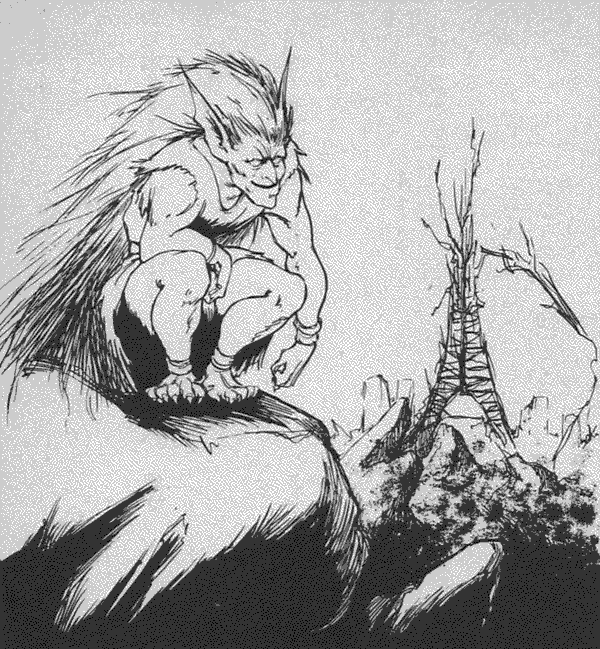 Source: Digital Devil Story Megami Tensei II Messiah Project 2036
A handful of observations for this game we love, which we couldn't think to fit anywhere else.
- Hidden Statistics
- All About Megami Tensei II and the Soundtrack Booklet
- Nebiros
- LOSARM
- Pazuzu
- Majin Tensei
- God Sider
- Cell Phone Differences
- God Himself
- The Waganizer
- Devil Buster
Hidden Statistics
- There is a hidden charisma stat that masks and helmets affect. Think twice before trying to recruit a cute demon when donning a spooky mask!
- Common to this and later games in the series, there is a hidden devil affinity rank for each demon you encounter, building on past encounters with neutral demons. (evil demons never progress). Unexpectedly, it goes down when you successfully intimidate a demon into your party, which can lead to them immediately running when you try to talk to them in the future.
- Death blows have been rendered non functional in KMT2, but apparently there are traces of its programming still in the binary! It's a very swingy mechanic in DDS:MT2 that works both ways.
- Human characters get all their Defence from armour, and will die in one hit later on without any. Meanwhile, each demon has a hidden and fixed Defence stat. Vitality only determines HP, no amount of additional investment in vitality will benefit the player if their HP is already maxed.
- Exclusively in Famicom MT2, demons that do damage by charging, like beasts, actually deal Gun-type damage! By contrast, only swords do Sword-type damage.
- The game gives a hint in the UI that indicates which element a demon’s physical attack is. If it says “X slashed!”, it’s Sword. Anything else is Gun. This MAY apply in KMT2, but has yet to be confirmed.
All About Megami Tensei II and the Soundtrack Booklet
- Ma's timelines and official history covers most of the hidden backstory revealed by these two works from 1990 and 1991 respectively. There's still a few more details in the margins...
- The All About Megami Tensei II story recap is notoriously written from God’s perspective. In character, he does not make a single hint of the game’s alternate ending where you can make a specific sequence of decisions to ally with Lucifer against the almighty one.
- Among the odd details highlighted, “The upper two floors [of the vault] were severely damaged”. That explains why there’s almost nothing in them, save one necromancer whom we become yet more familiar with in Shin 1.
- Mammon, as you might recall, was the demon who wanted Pazuzu's head. There is a note that “the first Messian was merged into Mammon.” Now that’s interesting and ambiguous.
There is a full section of the booklet, as told by Kazunari Suzuki on page 20, where he shares exactly what happens after the two endings, "frog stepping" (Millenium Kingdom) and "frog holding" (fight against YHVH), quoted below:
-
メガテンIIでは、その善なる道は、唯一神が用意した、千年王国への道のりだったという訳です。プレイヤーは “選ばれし民” の指導者として迎えられるのですが、選ばれなかった人々は、抹殺されてしまいます。そして世界は清浄なるものに生まれ変わります。
もう1つの道は、暗黒に捕らわれていた古き神々を復活させ、仲魔にし、唯一神を倒す道なのです。世界は混沌としますが、創造のエネルギーにあふれる世界となります。
-
- This excerpt comes from a short essay on "The World of Megami Tensei", prodding at the habits and expectations of the player in playing the Namco Megaten games to this point and comparing its outlook to Wizardry. The distinction being, Are you really the hero?
- "Frog stepping" sounds quite a bit like the law ending of Shin 2, and the Blasted Tokyo scenario of Shin 4.
- As for "Frog holding", well. Doesn't that sound like the polytheistic ending of Shin 5?
- After all this time, it seems Atlus never strayed far from Suzuki's plan.
Nebiros
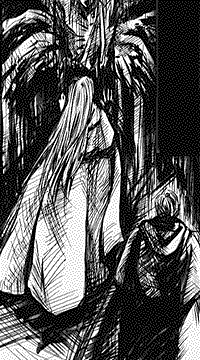
- It's easy to miss if you're not familiar with the original Japanese script for Shin 1, but the phrase that the Black Count shouts upon revealing in the Alice scenario that he's Nebiros is “若くて生きのいい体が2つもやって来たわい”.
- It is word for word the exact same line that he uses when meeting the Hero and the Dark Hero in DDS:MT2. If there was any doubt that the DDS:MT2 scenario was hinting at more interesting things to come.
 Source: Takako Matsumoto
LOSARM
- The ominous devil mouth from the Advanced Dungeons and Dragons module "Tomb of Horrors", also known as The Face of the Great Green Devil, seems like a clear inspiration for the LOSARM encounter.
- One twist is that while the original encounter is not intended to be messed with, and happens to be a death trap to set the tone for the rest of the module, the only way to progress in DDS:MT2 is to mess with the giant demon mouth!
Pazuzu
- The Dark Hero learns up to mid-level Zan and Agi skills… which are also what Pazuzu has! The best ones the Dark Hero can get are what Pazuzu himself has.
Majin Tensei
- Kazuma Kaneko recently revealed that the original title of the Namco-published DDS:MT2 was Majin Tensei. In a sense, this perfectly fits the story of the Namco game; Pazuzu and Lucifer are both Majin (demon gods) reincarnated and revived from their respective prisons over the course of the game's events.
- Unique to DDS:MT2, the overworld sprite of the heroine - visible when the hero dies in battle but the heroine lives on - is that of a woman in red with black hair and a considerably different outfit from the robed blonde witch of the game itself.
- Could this have been the original inspiration for the design of Majin Tensei's heroine?
- From the same source, the Heroine was the only one of two original character designs that Kazuma Kaneko did for that strategy RPG; the other being that of the predominantly blue hero.
God Sider
- This game takes heavy inspiration from the setting of God Sider, a Jump manga from Maki Kouji, an assistant to the Fist of the North Star manga. The most noticeable connection is in how closely Pazuzu resembles his God Sider design. He has the frame of a professional wrestler, a set of wings, and a human face with a fin on top. Don't just take my word for it...
- If not for the God Sider connection, Megami Tensei II's use of Pazuzu is quite odd given that he breaks with the theme of DDS:MT2 having western gods (Lucifer, Yahweh) as the primary antagonistic invaders of Tokyo, even though he acts and largely plays himself off as one during that particular game.
- However, God Sider's backstory references the Book of Revelations, with Halphas, Beelzebub, and Satan making prominent appearances.
- Lilith appears in this work as well, though Lilith doesn't make an appearance in a "Megaten" game until Shin 1.
- Volume five of God Sider has the heroes fighting a three way battle with a resurrected Pazuzu and Satan. We won't spoil what happens here, but needless to say, there are similarities between the three way of the Cult of Pazuzu, Satan and his minions, and the protagonists, as with the demons vying for control of the Messian wing, and Lucifer and his minions in MT2.
- It is likely that the Nihil Sword, a plot-relevant item in MT2 and a recurring item in later Megaten games, making a cameo in Persona 3 as well, is a direct reference to the similarly named blade that God Sider's protagonist forges in battle.
Cell Phone Differences
- DDS:MT2 for cell phones is a regrettably cut down port of the Famicom game. A major gameplay difference is that neither your allied demons nor the enemies have special attacks, severely reducing the variety of encounters.
- Some bugs remain in the final patched version that have been found that don't necessarily impede gameplay. If one head was not enough, Pazuzu can be fought multiple times...
God Himself
- From the surprise Mogwais to the chainsaw wielding Jason Voorhees, it's clear that the Atlus staff who worked on this game really enjoyed western 80s films.
- YHVH's appearance at the end tends to be compared by young fans with the Wizard of Oz as a giant floating head... but what if I told you there was an 80s film that already represented God himself as a giant, floating head?
- Take a look at Time Bandits sometime, and remember to return the map. You might even spot some similarities between this game's Makai and the Time of Legends.
- If there were any doubts left, Kazuma Kaneko himself offhandedly confirmed the influence. While musing about how the movie's take on The Devil is a robot, and how much he's been influenced by the Monty Python group in his work.
The Waganizer
- Among the DDS:MT2 Namco references and in-jokes, one premium item for sale is a sonic blaster known as the "Waganizer".
- This happens to be based on a spinoff of a variation of the carnival test your strength machine, only the twist is that it's to test your screaming.
- The original Wagan character that's the center piece of the machine, as architected by Namco, was promoted as a Gozilla-like tiny monster that gained strength from the energy of human screaming.
- It spawned a smaller home toy variant based on the premise of the original machine, and a voice sampling gun known as the Waganizer.
- With styrofoam packaging made to look like an ammo box, and instructions on the back hinting at special techniques for "Waganizer warriors", it does look like a weapon vaguely appropriate to the setting! Assuming demons won't burst out laughing at the cartoon lizard head on the barrel of this otherwise futuristic toy gun.
Devil Buster
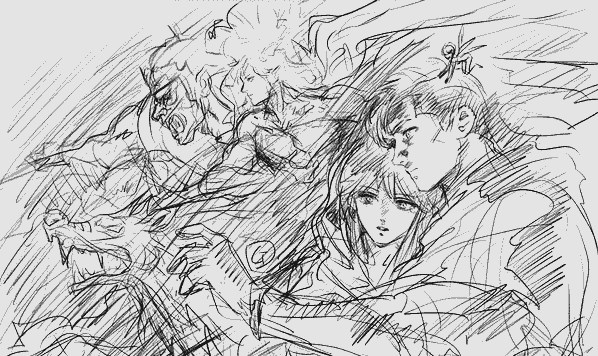
- In the Super Famicom remake, Kyuuyaku Megami Tensei, there is a bonus dungeon and a few unique demons available in the "Frog Stepping" route if the player finishes KMT1 before starting KMT2.
- Strategy guide graphic designer Seiji Ito relays that co-scenario writer Ryutaro Ito wanted to make the transition from KMT1 completely seamless to KMT2, by having Devil Buster replaced with the entirety of KMT 1.
- Imagine defeating Lucifer, and having the ending interrupted by Pazuzu! That would have made KMT2 a less faithful remake, and it would have made KMT2 the bonus unlocked by finishing KMT1.
- Then again, despite its tweaks to DDS:MT1 to make it more modern, KMT1 is still a little rough to play by comparison. Perhaps Atlus was afraid that without a fast path to KMT2, folks would have skipped on this remake?
 Source: Takako Matsumoto